
You're already the real thing. Everything here starts from strength.
Before any of the new stuff, the part that matters most: LT Generators is a family-owned company that has kept the lights on across Los Angeles since 1982, with three contractor licenses under one roof, Generac's top dealer tier, its own warehouse, and more than two hundred people who took the time to say thank you online. Most companies I look at are trying to become that. You already are. The site just hasn't caught up with the company.
What LT already has going for it
Five facts from your own site and the review sites. Any one of them would be the headline for most of your competitors.
What customers say
- task_alt"We were the only house on the block with lights on." Rochelle V., Los Angeles.
- task_alt"The first Santa Ana wind just blew this morning and all power was lost. We don't have to leave." Lani H., Malibu, who rebuilt after the Woolsey Fire.
- task_alt"Now all my neighbors are using their service." Andrea L., Beverly Hills.
The foundation under the website
- task_altEvery one of the 163 pages on the site loads and is set up so Google can find it. Nothing important is accidentally hidden.
- task_altThe homepage title says the right thing, and the license number is on every page, which is exactly the kind of proof Google and customers both look for.
- task_altReal city pages for Malibu, Beverly Hills, Bel Air, and the Palisades, written by someone who knows the neighborhoods. They just need to be linked from the rest of the site.
- task_altThe site already shows up for most of the searches that matter, without paid help. Nothing on this page replaces that. It builds on it.
Every idea on this page is only worth doing because the company behind it is real. A new customer can't see forty-four years of good work from a search result. They see a website.
The goal isn't to change what LT is. It's to make the first impression online match the one people get when your crew shows up.
So, the first idea: a new homepage.
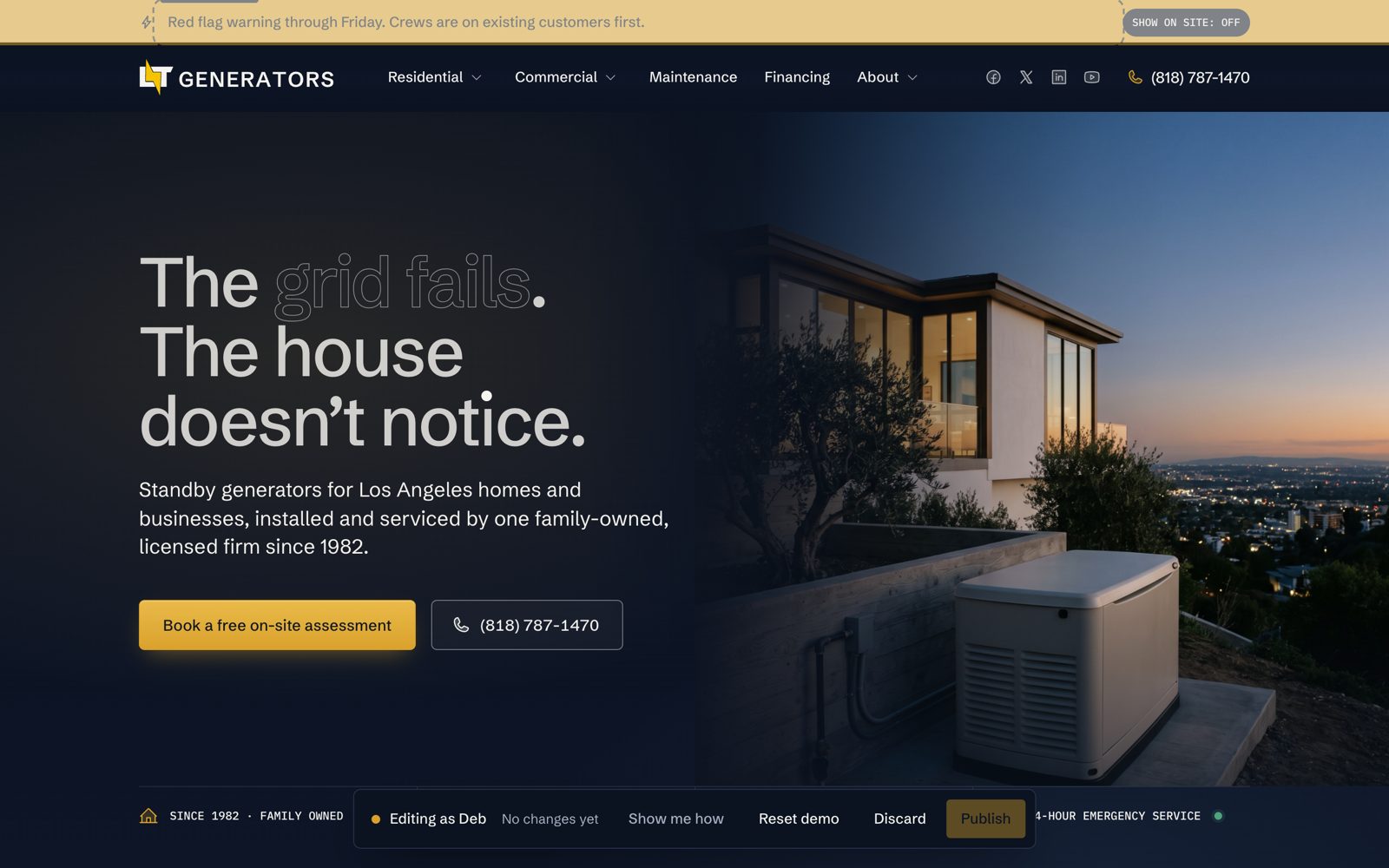
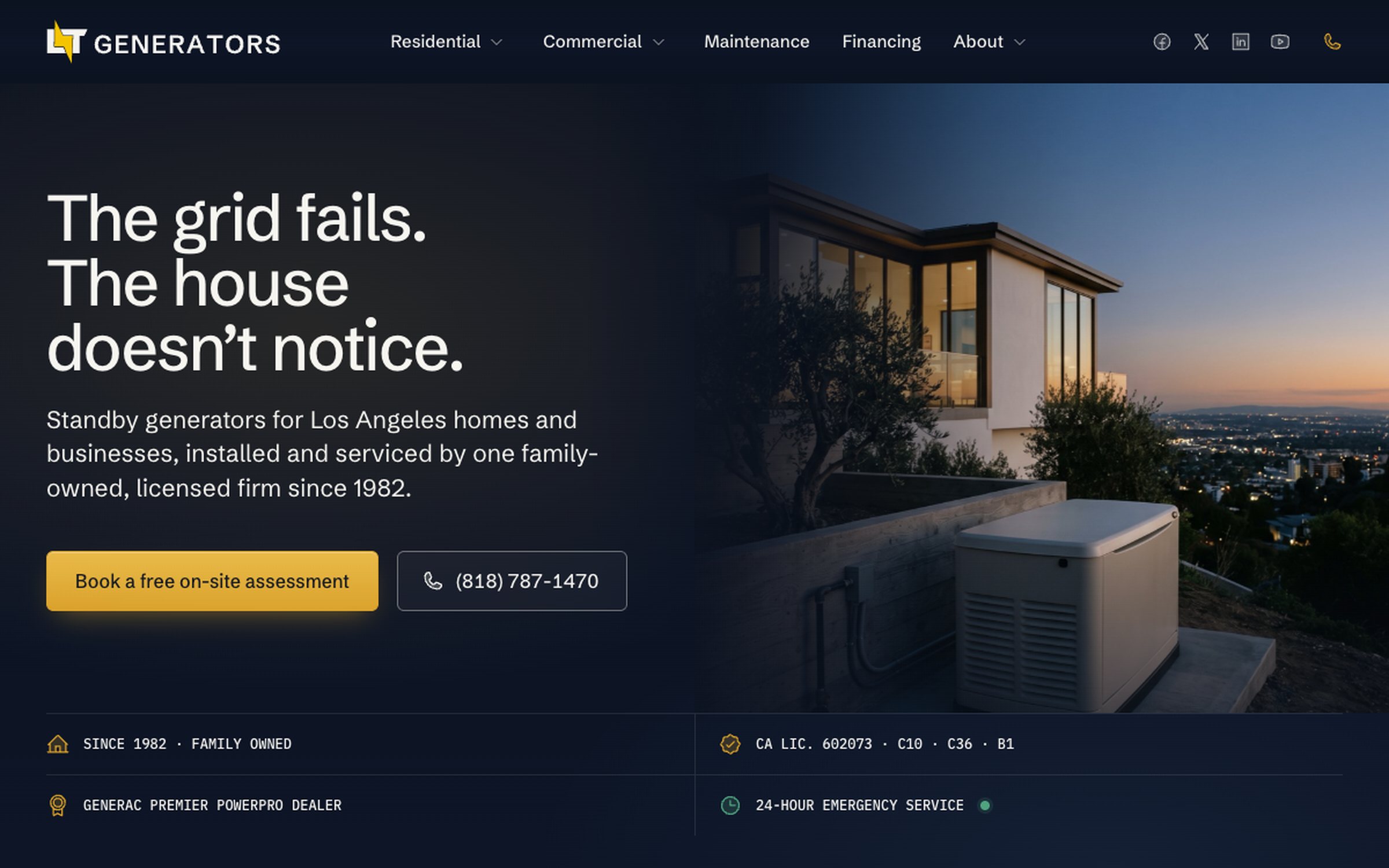
This is a working draft of what ltgenerators.com could look like. Nothing on it was made up. Since 1982, the three licenses, the Generac top-dealer status, the warehouse, the reviews, the financing: it's all on the current site already, just spread out and easy to miss. The new page puts it in the order a customer needs it, starting with what a generator does for their house and ending with the free assessment. Click into it, scroll around on your phone, and see how it feels.
 open_in_newOpen the new homepage
The whole page, and the phone version
The new homepage top to bottom, and how it looks on a phone, which is where most people will meet it, often during an outage.

Four things the new homepage does differently
What changed compared with the site today, in plain terms.
It starts with what matters to a homeowner
The first thing on the page is what a generator does for a house when the power goes out, in one line. Then how it works in four steps, then what stays on. The word "generator" comes second; what it does for you comes first.
Your credentials are right up front
Right under the opening photo: since 1982, ten years of warranty, 200+ reviews, and the license number in gold. The three licenses are listed plainly, because that's the first thing a careful homeowner or an estate manager checks.
Your customers do the talking
Five real reviews from your testimonials page, including the family who rebuilt after the Woolsey Fire. Real neighborhoods, and photos that look like Los Angeles instead of stock skylines.
Built for someone on a phone, in the dark
On a phone, the "book an assessment" button and your number stay at the bottom of the screen as you scroll. The page is light, so it loads fast even on a weak signal.
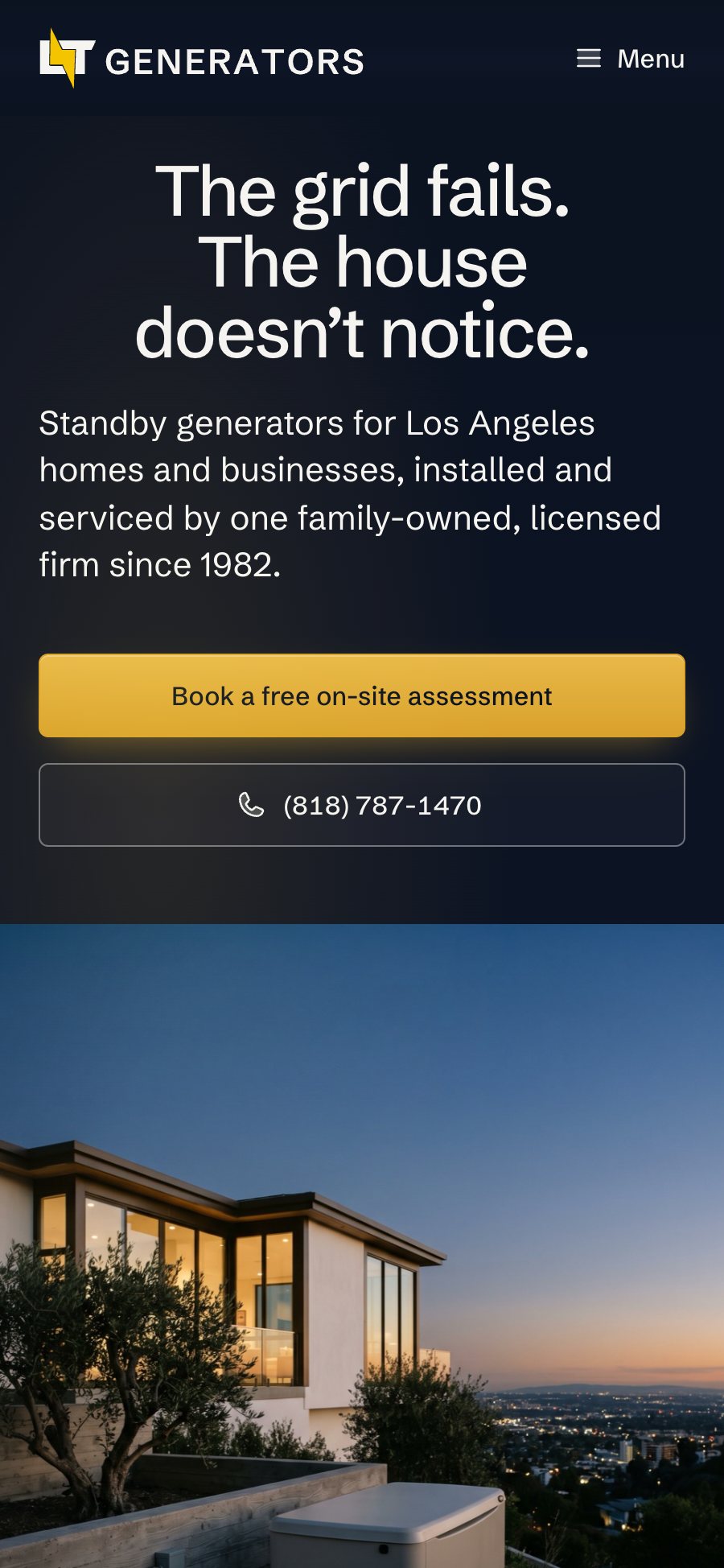
Side by side
Your site as it is today on the left, the new draft on the right. Both scroll inside their frames.
boltA thought starter, not a spec. Every section, photo, and line of copy here is a first pass to react to. If we build this together, we'll work out what actually fits LT, with you.
For most new customers the homepage is the first handshake. If it loads slowly or the phone number is hard to find, many of them call the next company on the list.
A page that loads in a couple of seconds on a phone, says the important things first, and makes calling a one-tap thing. More of the people who already found you actually reach you.
Three things change often. So those three are the only things with a button.
Most small-business sites never get updated because updating them means logging into a dashboard with a hundred things on it, none of which you need. This one has a single link for the office. Open it, click the thing that's wrong, fix it, press Publish. The whole site stays hand-built and bespoke; the parts that move are the parts you can touch.
The three things the office can change
Each one below is shown as it looks with editing switched on. The yellow outline means "you can click this and type."
A yellow bar for the days that matter.
Santa Ana wind event, PSPS shutoff, a fire. Type one sentence, switch it on, it appears at the top of every page. Switch it off when it's over. No developer, no ticket, no waiting.
Type the sentence. Switch it on. It sits above the nav on every page until you switch it off.
Plus and minus. That's the whole inventory system.
When a unit ships, the office taps minus. When a pallet arrives, plus. Add a model, remove a model. Customers see live counts, and "we can install from stock" stops being a claim and becomes a list.
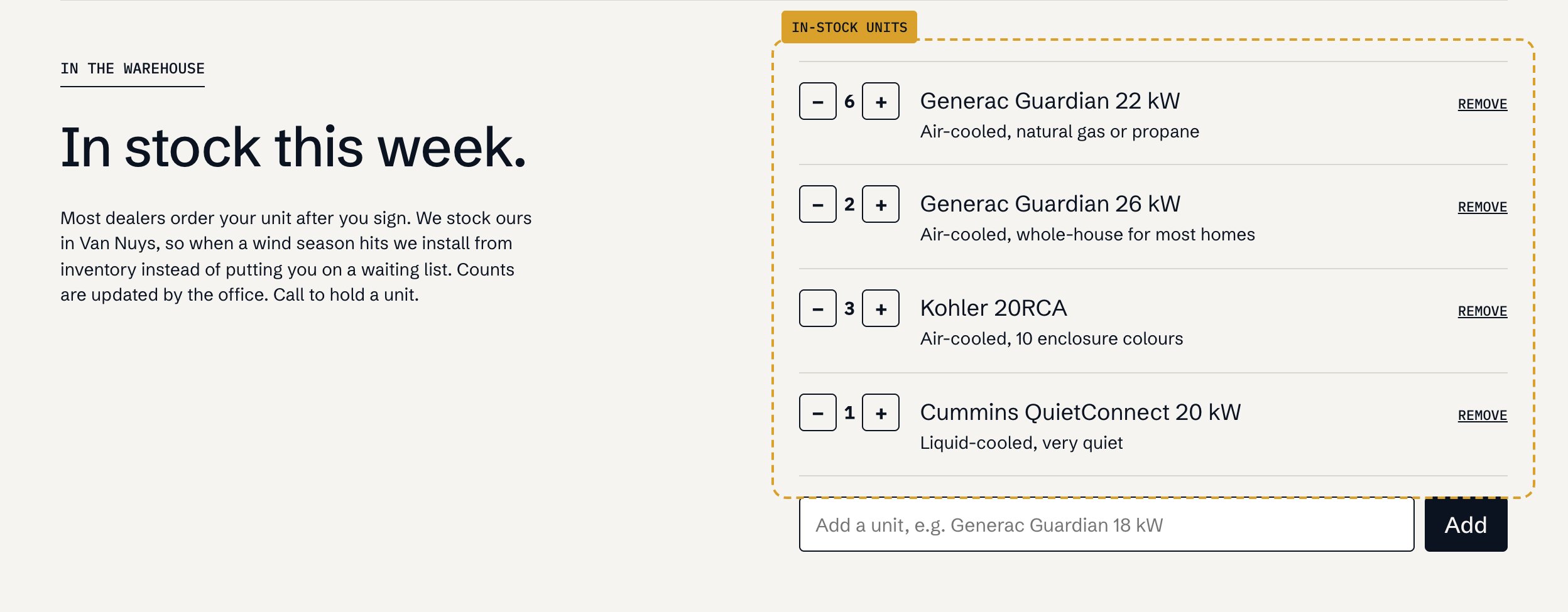
Holiday hours in the time it takes to type them.
Click the hours, change them, publish. Same for the phone number, the address, and anything else we agree should be editable. Everything else is locked, which is what keeps the site looking designed a year from now.
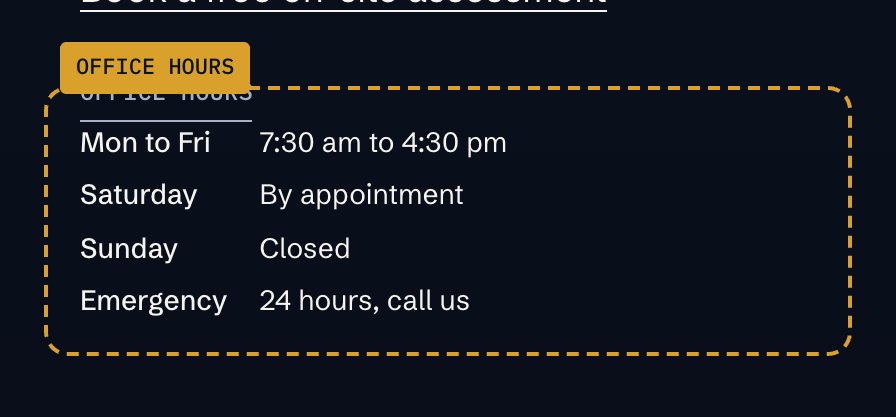
This is a working demo, not a mock-up: open it with editing on and a short tour points at the three things you can change and the Publish button. In the demo, changes save to your own browser. In the real thing, Publish sends them to the live site and you get an email confirming what changed.
boltA thought starter, not a spec. The three editable things are my guess at what changes most. If we build this together, we'll pick the real list with the office.
Websites go stale when changing them means calling somebody. Outage notices, hours, and what's in stock are exactly the things that change on the worst days.
The office keeps the site current in the time it takes to type. During a wind event, the website says what the phones are saying.
Keep the mark you own. Redraw it clean.
The L, the bolt through the middle, and the T are on trucks, yard signs, and forty years of invoices. They stay exactly as they are. The refresh redraws them as clean vector, keeps the bolt's keyline, and sets GENERATORS in the new site's own typeface, letterspaced wide. Same logo, sharper. Three other directions from along the way sit below, just as explorations.


 Today
TodayFour ways the logo could go
The first is the one I'd recommend. The other three were explored along the way. Click any card to see its full sheet.
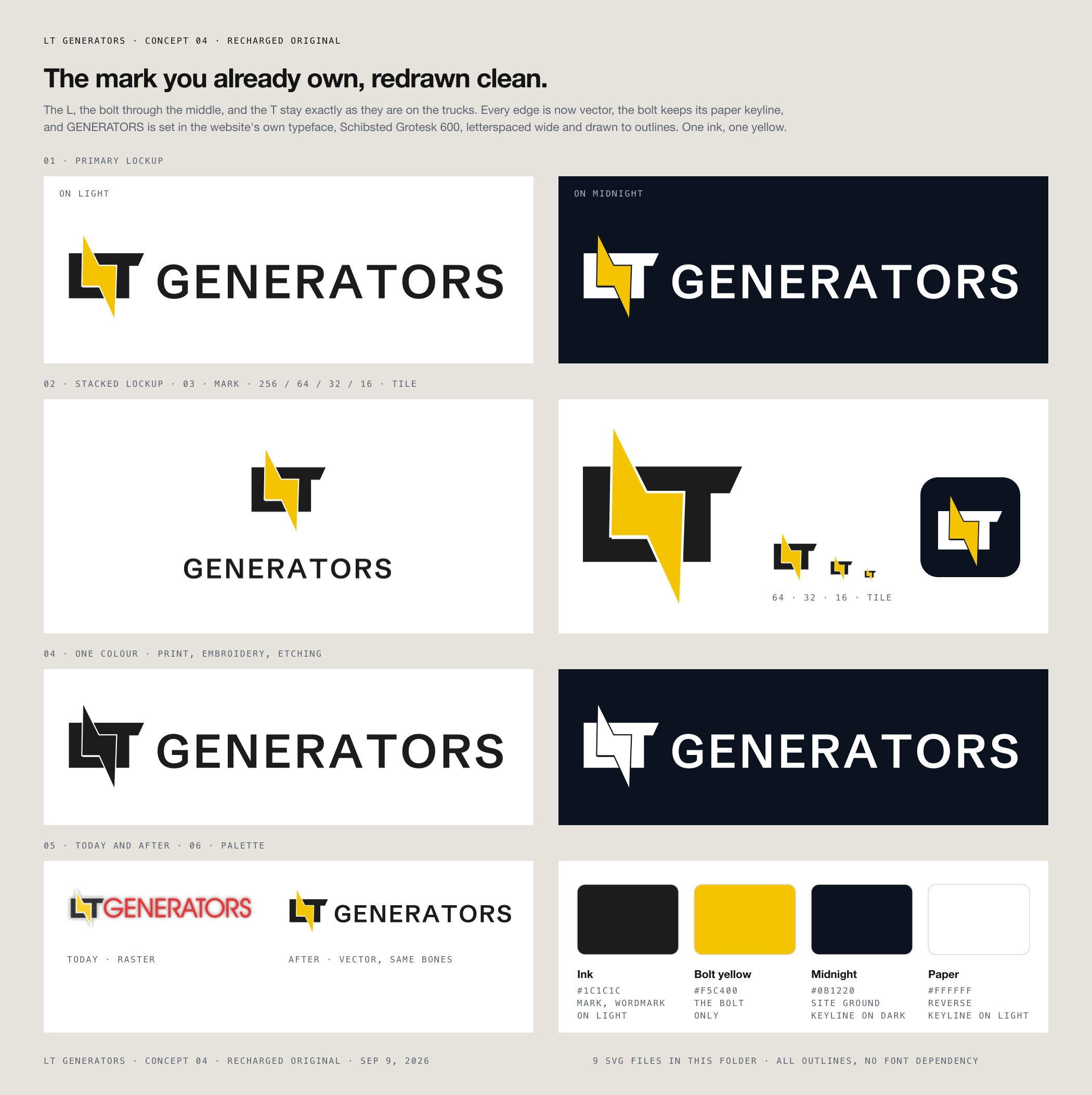
The mark you already own, redrawn clean.
Same bones, vector edges, one ink, one yellow. The bolt keeps its keyline; the shadow and the red go.
Full sheetopen_in_new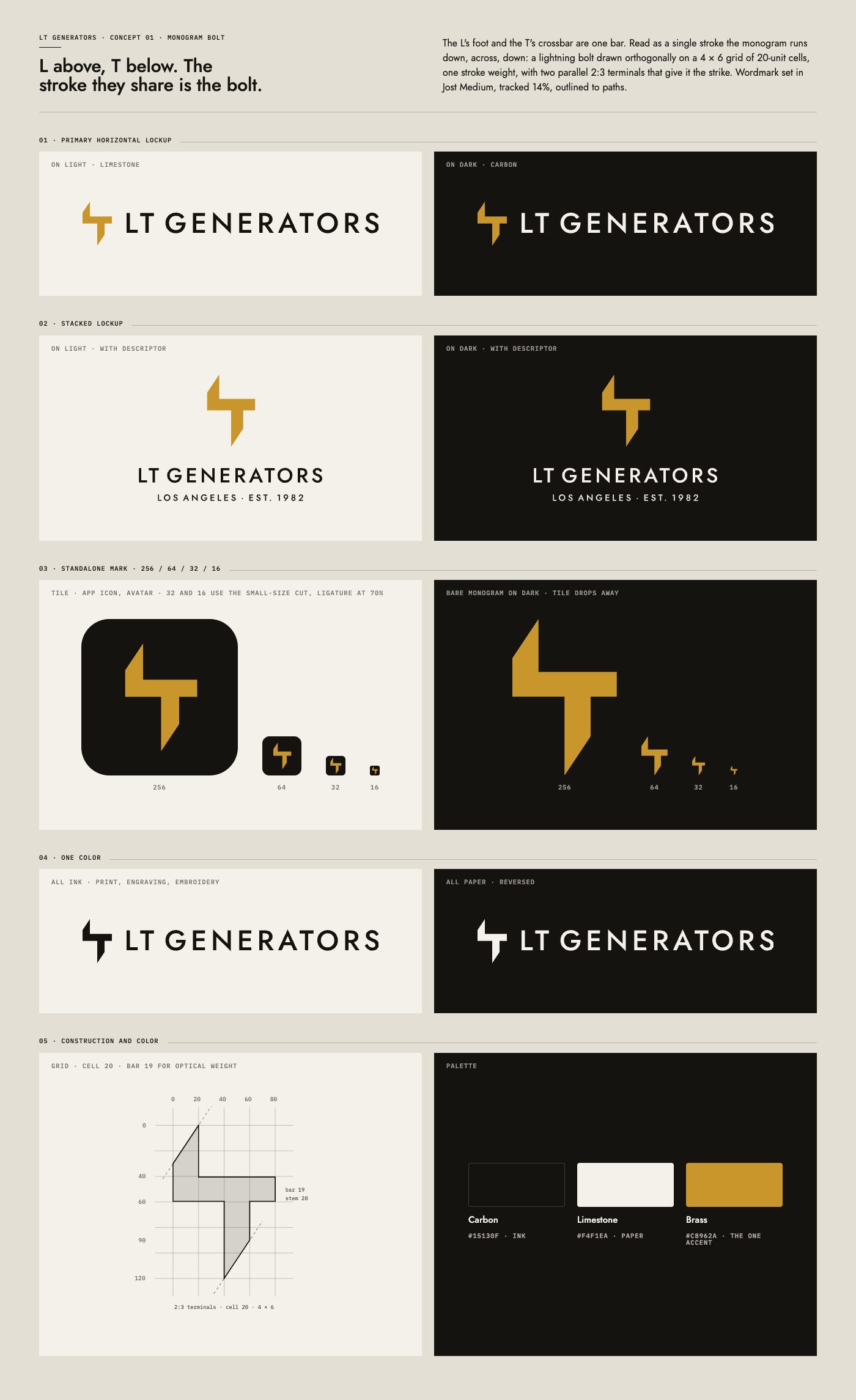
L above, T below. The stroke they share is the bolt.
A geometric monogram on a grid, brass on carbon. Reads at 16 px. The most "estate manager" of the three.
Full sheetopen_in_new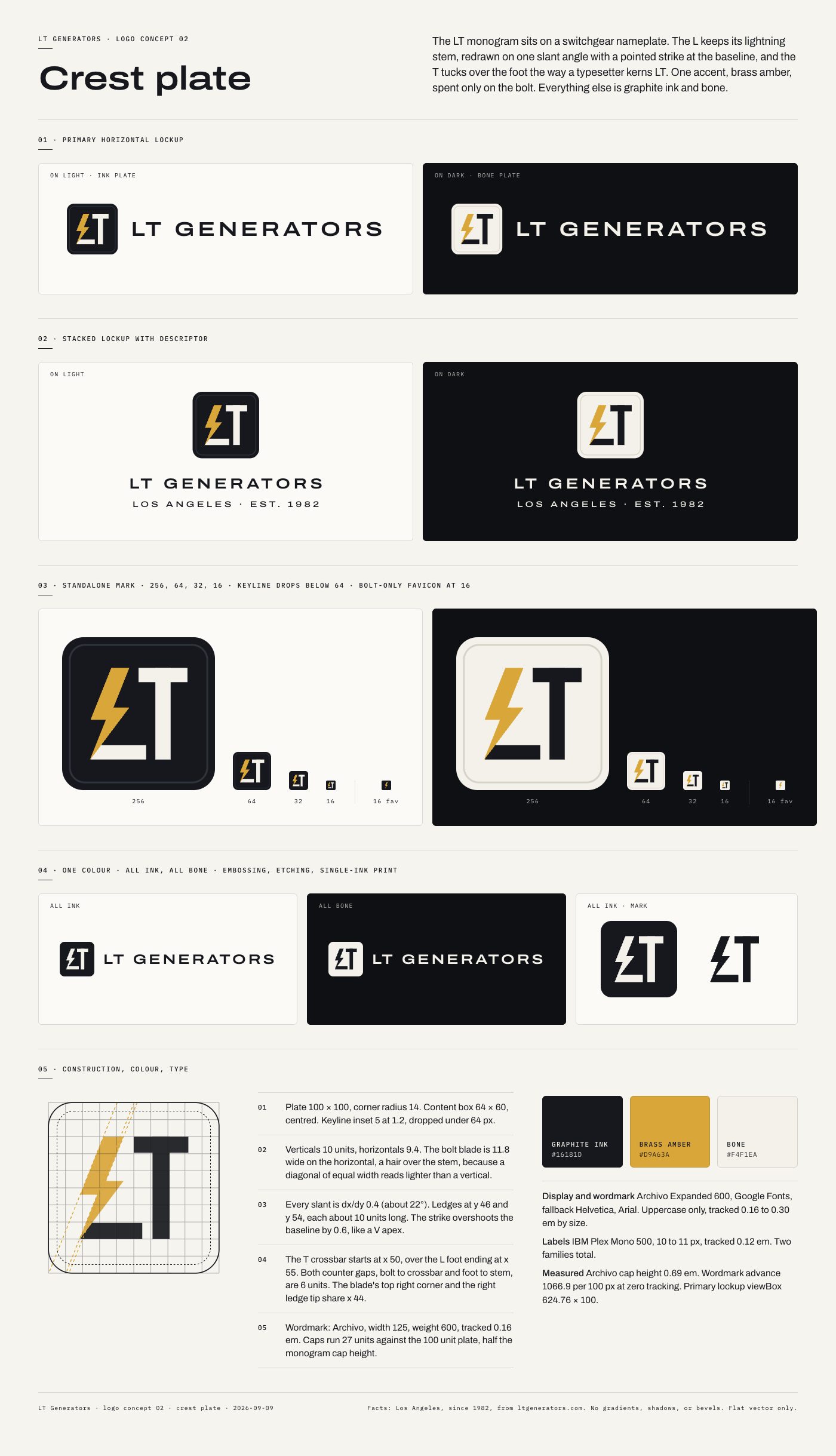
The monogram on a switchgear nameplate.
A bolt-stem L with the T tucked over its foot, on an ink plate. Closest to the current logo's energy.
Full sheetopen_in_new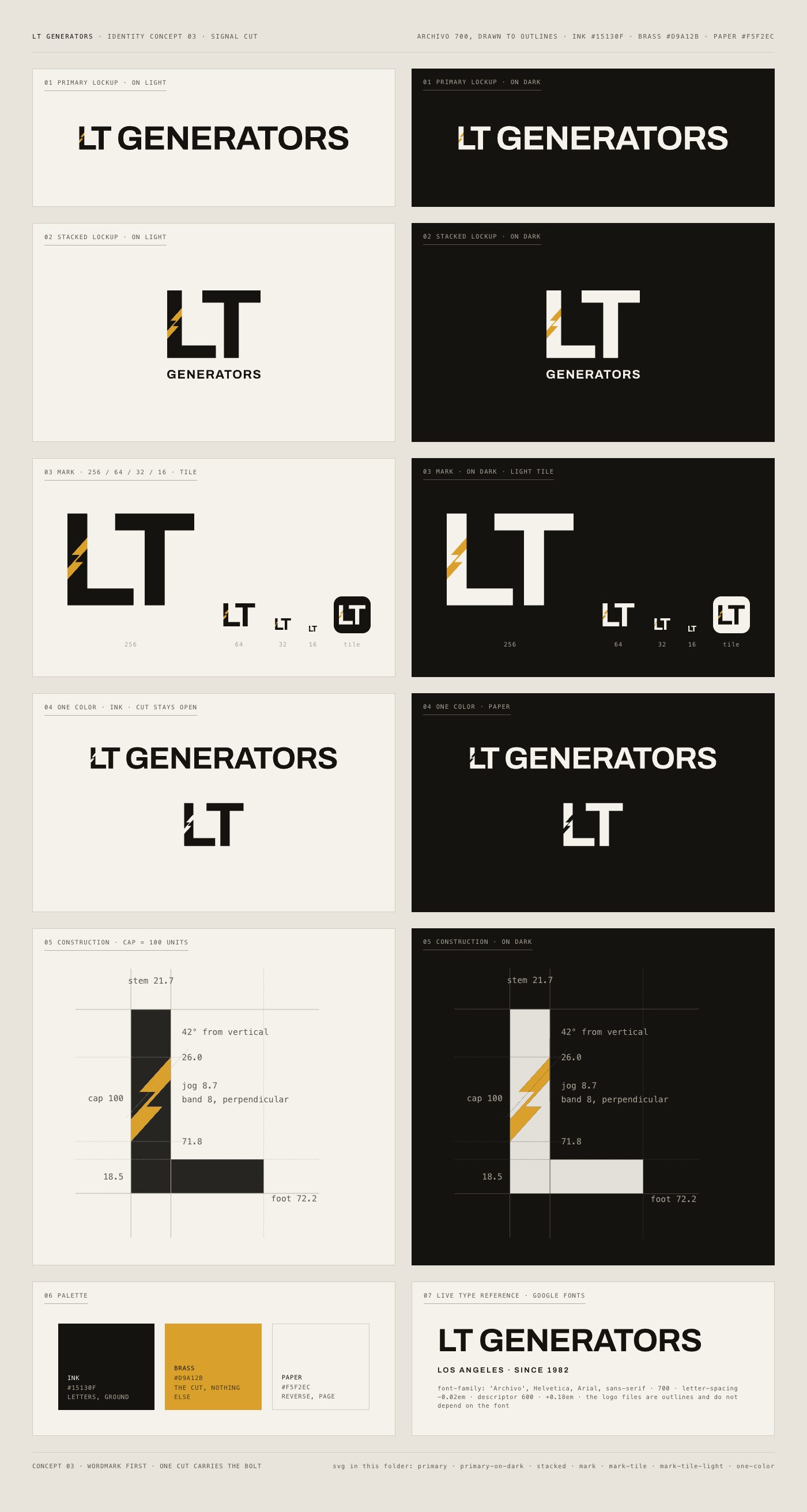
Wordmark first. One cut carries the bolt.
Heavy caps, and the bolt lives inside the L as a brass cut. Quietest at a distance, sharpest up close.
Full sheetopen_in_newKeeps
- task_altThe LT bolt, in every direction
- task_altOne accent colour, spent only on the bolt
- task_altGenerac, Kohler, and BBB badges where they earn trust
- task_altEvery fact, phone number, and license
Retires
- task_altThe red diagonal slashes over the hero
- task_altSolid red and solid black page bands
- task_altFour shades of red and a pixelated favicon
- task_altStock city skylines standing in for service areas
Each sheet shows the logo large and small, on light and on dark, in one colour for print and embroidery, and how it's drawn. If you'd like, the next step is a two-page brand sheet the office can hand to anyone making a truck wrap, a yard sign, or a Yelp ad.
boltA thought starter, not a spec. Four ways to draw the mark, none of them final. If we build this together, the logo gets decided with the people who put it on the trucks.
The logo is already known on trucks and yard signs. What's missing is a clean version that works everywhere: embroidered on a shirt, printed on a card, tiny on a phone screen.
One set of files the office can hand to anyone. Every truck wrap, sign, ad, and web page looks like the same company.
The current site, audited page by page.
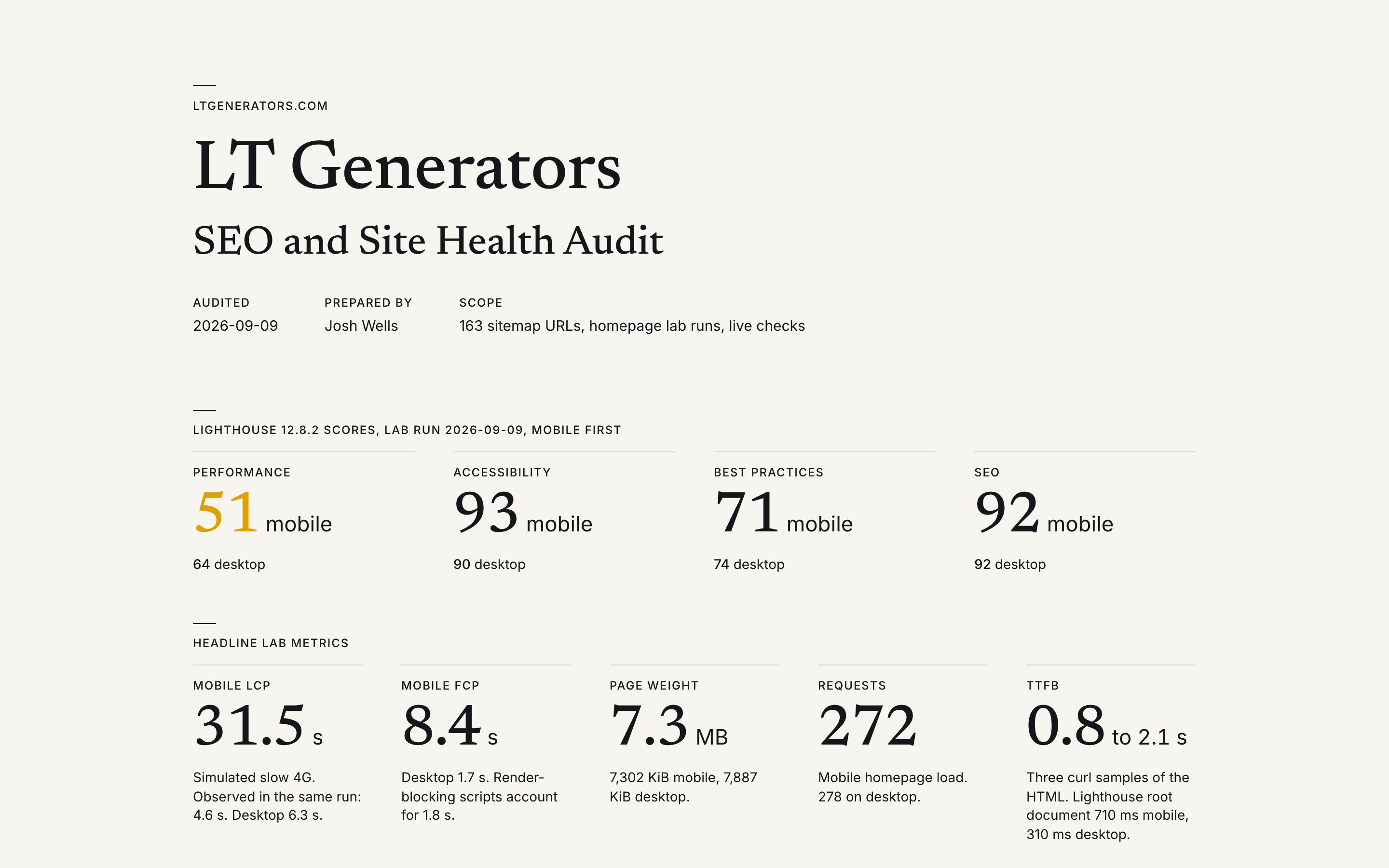
I ran a full audit: all 163 pages in the sitemap, Lighthouse lab runs on phone and desktop, the schema, the sitemaps, the robots file, the ad tags, and a search snapshot against the competitors. None of this is anyone's fault; it's what happens to a WordPress site over ten years of plugins. The foundation is sound. The problems sit on top of it, and most are settings work.
Five numbers from the audit
Measured on your current site on Sep 9, 2026. The first two are about speed, the third is about the phone, the last two are about search.
The five things to fix first
- task_altMake the phone number tappable on phones. Every mobile visitor can call, and the ad account can finally count the calls.
- task_altFix what Google is told about the business. The site's structured data carries a placeholder 800 number, "Your Street Address", and the name spelled "LTGenerator" on every page.
- task_altShrink the hero and load the booking widget on click. About 3 MB and 77 requests leave every page load.
- task_altClean the index. Ten test and demo pages, five identical battery-storage pages, and three tag archives are indexable today.
- task_altLink the four city pages. Malibu, Beverly Hills, Bel Air, and Pacific Palisades pages exist and are good. Nothing links to them.
What's already right
- task_altAll 163 pages load, every one has a canonical, and no money page is accidentally hidden from Google.
- task_altThe homepage title is hand-written and on target. The license number is visible sitewide, a strong trust signal.
- task_altLayout is stable, text is compressed, HTTP/3 is on, redirects are clean. The plumbing works.
- task_altReviews are strong and all at one address: Yelp 127, BBB A+, HomeAdvisor, Angi, Nextdoor.
- task_altThe homepage already shows up for most head terms without paid help. The work is to move it from sixth to first, and the rebuild above is built to do that.
 open_in_newRead the audit
LT Generators, SEO and site health audit
Nine sections and 63 numbered findings, each with the file or live check it came from, an effort estimate, and a roadmap a WordPress developer can start on this week. Lab data, dated, with the limits stated.
Read the auditopen_in_newEvery timing number is lab data from one run per device on Sep 9, 2026. Search positions are a snapshot, not tracked rankings. With access to the site's Search Console the audit gets real impressions and clicks; that's part of the first conversation.
boltA thought starter, not a spec. The audit is real and the numbers are measured. What to fix first, and in what order, is a conversation, not a decree.
Nobody can fix what nobody has measured. Most of what the audit found are settings, not rebuilds, and each one on its own changes whether a customer reaches you.
A short list a developer can work through in about two weeks, biggest wins first, with real numbers to check against afterward.
People don't search the way they used to. Here's what that means for a generator company.
Ten years ago a customer typed "generator installer" into Google on a desktop and called the first ad. Today most of them are on a phone, often during an outage. Many ask a question out loud or type it into an assistant like ChatGPT and read a single answer instead of a list. Nearly all of them read reviews before they dial. None of this is a reason to worry. It's a reason to be ready, and the company with the real credentials has the easiest job of all.
Six numbers about how people look for a local business today
Each comes from the source named under it. The exact figures move every year; the direction hasn't changed.
What this means for LT, in three moves
None of these is technical from your side. They're about making sure the truth about LT is easy to find and easy to trust.
Be easy to find
Your Google listing, your website, and the review sites all say the same hours, address, and phone number. The city pages for Malibu, Beverly Hills, Bel Air, and the Palisades are linked so Google knows they matter. Google is told directly when something changes.
Be easy to believe
The license number, the years, the reviews, and photos of your real crews and real installs, on every page. A phone number that works with one tap. The things that make someone comfortable calling a stranger about a $20,000 job.
Be easy for the assistants to read
The AI assistants build their answers from plain pages that answer real questions the way a technician would. A short facts file about LT that the assistants can read, and one honest page per city, and "who installs generators in Malibu" comes back with your name and the right number.
The way people look for a generator installer has changed more in the last two years than in the ten before. They ask their phone, they ask an assistant, and they read reviews before they call.
Being the answer, not just a result. When someone in Malibu asks “who installs generators near me,” LT is what comes back, with the facts right.
boltA thought starter, not a spec. The figures are the sources' own, and some are a few years old. What we'd do about them gets decided together, one step at a time.
Five things that happen in the first two weeks.
None of these wait for the new site. They're the things I'd do the week after we shake hands, because each one moves the phone or the search results on its own, and each one is small enough to finish before the design conversation is over.
A way to ask a question, on every screen
A small "Ask a question" button that opens call, text, or a two-line form, answered by the office, not a bot. It's already on the mock: open the homepage and look bottom right. On the current site it can go in as a widget the same week.
Work the audit's quick wins
Fifty-five of the sixty-three findings are settings changes in WordPress. Make the phone tappable on mobile, fix what Google is told about the business, take the test pages out of the index, link the four city pages. Two weeks of a developer's time, no new copy.
Get properly in front of Google
Claim Search Console, resubmit the real sitemap, check the Business Profile matches the site (hours, address, phone, categories), and ask Google to re-read the pages that changed. Then we have real numbers instead of lab numbers.
A writing plan for the AI assistants
People now ask ChatGPT and Google's AI for "a generator installer in Malibu." Those answers come from plain-English pages: one per city, real questions answered the way a technician would, and a facts file the assistants can read. A short plan, then one page a week.
Find out what the ads are doing
The site carries Google Ads tags. Either money is going out or it isn't, and right now the ads can't count phone calls either way. A look inside the account says whether to fix it, pause it, or leave it alone.
boltA thought starter, not a spec. These five are my guess at the fastest wins. If we build this together, the list gets set with whoever runs the office and the phones.
Momentum. Small, visible improvements in the first two weeks build trust on both sides before the bigger work starts.
More calls counted, cleaner search results, and a way to ask a question on every page, before the new site even goes live.
One conversation first. Then only what's useful.
I don't want to sell LT a website. I want to build the one thing that makes the phone ring more and the office's week easier, and then keep it that way. That starts with thirty minutes.
Three steps, in order
Nothing after the first one happens unless the first one goes well.
A conversation
Thirty minutes with whoever owns the decision. What's working, what the office is tired of, what a good year looks like. I bring this page and a notebook.
The site and the brand, as one project
The homepage you just saw, plus the pages behind it (residential, commercial, service, financing, contact), the editing layer, and a brand sheet. One flat scope, one number, no surprises.
A second conversation
Search and AI presence, reviews, how the office keeps its information today, and whether the tools you already pay for (like ServiceTitan) could talk to the site. Optional, month to month, only if it earns its keep.
Nothing here is a commitment. If the answer after step one is "not now", you keep the ideas and the preview.
boltA thought starter, not a spec. The steps above are a starting shape. If we build this together, we'll come up with what fits LT, and nothing else.
Big projects go wrong when nobody agreed on the first step. One conversation first keeps this small and honest.
Thirty minutes decides whether any of this is worth doing. If it is, the next step is already clear.
Josh. This is what I do.

I've spent twenty years as a creative director, mostly in entertainment: TMZ, Amazon Studios, Banijay. The job was always the same underneath: take something complicated, make it clear, make it land. These days I design the thing and build it myself, which means there's no hand-off where the idea gets lost and no agency in the middle marking it up.
What I like doing now is exactly this: taking a local business that's genuinely good at what it does, and giving it a website and a brand that say so, built so the people who run the business can keep it current without calling anyone. That includes the technical side nobody sees: fast pages, structured data Google can read, and copy written so the AI assistants people now ask for "a generator installer in Malibu" find LT and get the facts right. Useful now, built to grow, and ready for where search is going.