
Life’s complicated enough. The work doesn’t have to be.
I know that sounds like something printed on a mug. But I’ve spent twenty years watching good projects get heavy for no reason: a proposal nobody finishes reading, a number nobody’s allowed to move, a deck that explains the idea instead of showing it. Almost none of that weight was necessary. A lot of it was me.
So this is the list. Ten things I picked up slowly, usually the hard way, that made the work simpler and (this is the part I actually care about) more fun. For me, and for the people I get to make things for. Nothing here is a system. It’s closer to manners.
01 · No number is set in stone
Have a range you’re comfortable with, not a figure you’re defending. I’d rather take the lower tier of a job if there’s a relationship on the other side of it. Some of my best clients started small, well inside their budget, and as they grew I got to grow with them. The work got bigger because the trust got bigger. Not because I held a line in year one.
A quick buck is sometimes the point. I get that, I’ve needed one. But when you can ride the wave, ride it. Work with your client the way you’d want them to work with you if the roles were reversed, which usually means the first conversation isn’t about the number. (If you want the actual numbers, I wrote down what a redesign costs and the ranges are all in there.)
02 · Write to one person
Not a corporation. One person. Even when I’ve written decks and proposals for Amazon, I’ve tried to bring it back to who’s actually going to read this thing. Not an audience. A person, with a Tuesday.
Whatever I’m making, a pitch, an email, a comment in a doc, I want some humanity in it. Some days that’s me catching my exclamation marks (I overuse them, and I’m never sure if I’m being warm or screaming at people). Some days it’s giving a proposal a stepped navigation so nobody has to hunt, and writing it in words you’d say out loud instead of the words that sound like a company.
Stakeholders will be provided with a lightweight content management framework enabling streamlined, self-service publication of operational updates, thereby reducing dependency on external resources and optimizing time-to-market for critical communications.
When the office needs to say "closed Friday" on the site, you'll type it, hit Publish, and it's up. About thirty seconds, no ticket, nobody to call. The same goes for prices and office hours.
There’s nothing more satisfying than a document, or a proposal, or a design sitting in front of you that just WORKS. It feels like you made it yourself. The answers are already there before you ask. And if you can get that feeling into how you position yourself, the people you work with stop reading you and start trusting you. That’s the whole trick. It isn’t a trick.
03 · There are no bad ideas
Just ideas we won’t use right now. I say it constantly, and I mean it as a filing system, not a pep talk. Stay on top of your schedule, and when you’ve got room, overdeliver, because the extra thing becomes something you pick up later. I’ve lost count of the times I’ve pulled an older concept off the shelf, dusted it off, and rebuilt it into something useful for a project it was never meant for. The logo that lost the vote is a sticker two years later. The layout that was “too much” is exactly enough for someone else.
04 · Make the proposal a joy to read
I’ve built a solid chunk of my career in PowerPoint and Keynote and Slides, and I’m not knocking a deck. But we can make experiences now that go past a deck, and if you can show the idea instead of describing it, why wouldn’t you?
Here’s one I put together for a family-owned generator company in Van Nuys. No price, no scope. A working draft of their homepage, a lighter take on the brand, and a demo of the office editing the site themselves.
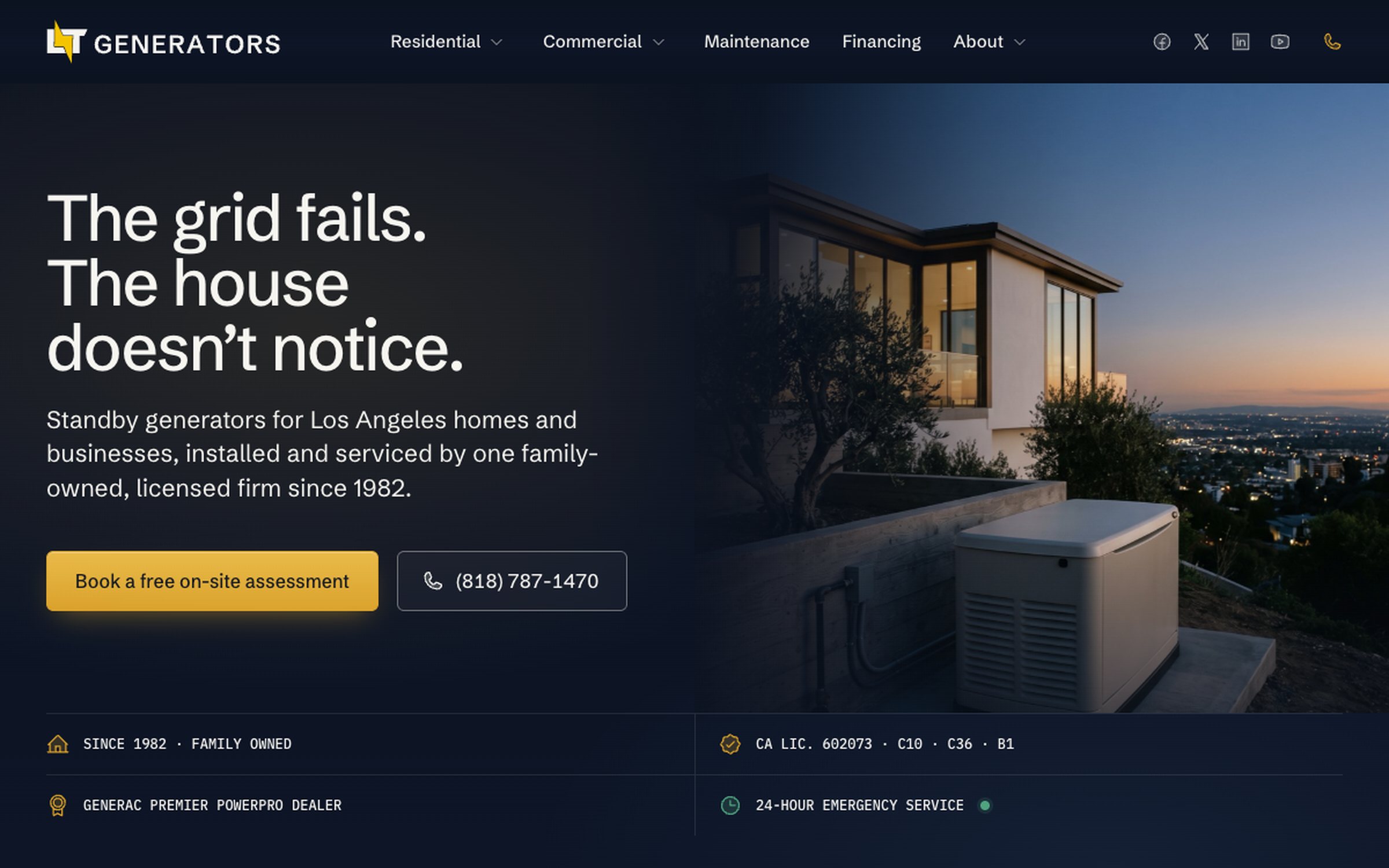
If you can show your idea, give a teaser of what it could be, and offer a simple answer to the problem they’re actually trying to solve, you’re already ahead of most of what lands in an inbox. You want them to feel something. The easiest way I’ve found is to surprise them with how real it already is.
05 · Track your time, then keep tracking it
I’ve fallen victim to all of it. Over-scheduling, falling behind, missing deadlines I could’ve avoided if I’d (a) planned better and (b) not promised the moon on a Tuesday afternoon because the call was going well. Most of my worst weeks came from a yes I said too fast.
So track the hours, honestly, and keep tracking them after the week you swore you’d start. Then give yourself grace. Life happens. Allow yourself to recharge. And if you’re burning out, say so to your clients, early, in plain words. Nothing’s more refreshing than clear comms with the people you get to create for. They’d rather hear “next Thursday” today than “sorry” on Friday.
06 · One more thing
If you have the time, and it fits the deliverable, give the client one more thing. It doesn’t have to be a design. On my proposal pages it’s a way to leave a note on any section, right there, without starting an email thread. Try it.
Three things slowing the site down
The homepage weighs 7 MB and takes half a minute on a phone. Nobody waits that long for a generator.
Or maybe it’s an extra logo direction you liked too much to leave in a drawer. If it doesn’t take away from your creative worth, add a little something to each round, so the client learns there’s always something to look forward to when a link from you shows up.
07 · Give them what they asked for. Then surprise them.
A client wants to be heard. If what they asked for is wrong, it’s our job as designers to know which kind of wrong it is. Visual thinkers can see in a second that an idea isn’t going to work. Not everyone has that sharpened, and they shouldn’t have to. So deliver what they asked for, to the best of your ability, for real. Not a strawman version you built to lose.
Then you’ve earned the right to color outside those lines. That’s where you get to excite someone with a thing they didn’t know was possible, and it only lands because the thing they DID ask for is sitting right next to it.
08 · Say what happens next
Every email, every round, every call ends with the next step and a day. “Second pass to you Thursday. If that moves, you’ll hear from me before it does.” One sentence. It removes the question everyone’s too polite to ask, which is “so… what now?” Of everything on this list, this is the one people thank me for most, and it’s the one that costs the least.
09 · Send a link, not an attachment
One URL. The proposal lives there, the latest version is the only version, and when it changes, the link doesn’t. No “final_v7_FINAL2.pdf.” No five-person thread about which one is current. I stopped delivering files a while ago and it’s quietly the best thing I’ve done for the people I work with. They’ve got one place to look, and so do I.
10 · Build it so they don’t need you
The kindest thing I can leave a client with is the ability to change their own site without calling me. An outage banner, office hours, a price. Thirty seconds, no ticket. That generator company’s draft ships with an edit mode for exactly this reason. It isn’t giving the work away. The work was the thinking. I’d much rather get the call about the next idea than the call about the typo.
That’s the list. Nothing on it is clever. Most of it is remembering there’s a person on the other end with a Tuesday just like mine, and making their part of it a little lighter.
Life’s complicated enough. The work doesn’t have to be.